 Why do some young adults wander away from the Church? There are no easy answers to this. At least, I have not found one in my own experience of ministry. I have seen some young people fully immersed in the Church in high school and college who then just stop coming one day. I have seen other young people who had wandered off come back with a great fervor almost bordering on zealotry. A good number of young people I have known wander in and out with some choosing to stay loosely connected on the periphery of the Church.
Certainly each person’s journey of faith is unique. There are movements in the heart that only God can see and everything occurs in God’s time. We all know that there are scandals within the Church that wound hearts and discredit the gospel and the community. There are voices against the Church and Christianity in our world and caricatures of religion too easily tossed about in society. There is a diffused mistrust of all institutions. There are also people not willing to change their view of the Church just as they, themselves, insist the Church must change (usually to their liking). Finally, there are some people who are just lazy spiritually.
With all this in mind, I am firmly convinced that young adults need the Church. No one may be able to adequately answer the big concerns noted above. Still, I want to offer a few thoughts about why young adults need the Church. Here are the thoughts in the form of a letter.
Dear young adults,
Do you know that you need more than just your peers? I never really became a fan of the TV show “Friends”. I do remember watching it and being entertained although I didn’t always agree with the moral choices portrayed in the show. I remember that the whole universe portrayed in that show was that of a group of peers. Every now and then a person from another generation (younger or older) would pop in and out of the show but they seemed to be just a distraction. Everything centered on that particular group of peers and their enclosed world. I have seen this same theme continue in newer generations of shows. I am sorry, but that is not life. Sadly, though, I think society and, surprisingly, the Church have followed suit. There are retreat programs and youth ministry initiatives intentionally and exclusively structured around peer-given talks and peer-led discussions. There are youth only liturgies. I would wager that the same trend can be seen in education, athletics and all forms of engagement with our youth. Is there a certain value and place for this? Yes, but there are unintended consequences. Dear young adults, I apologize. You have been done a disservice. Although no one intended it, you have been taught to only value peer input and peer relationship. The voices of other generations – the insight, knowledge and wisdom of older generations that can help guide in life and help navigate its struggles as well as the hopes and dreams of younger generations – have been blocked from your awareness. With this block there can also be a forgetfulness of how God has been faithful and active in all generations and how God continues to be faithful and active.
In my ministry with young adults I often felt frustrated by this block. Over time, I learned to not get upset or frustrated by this. They were just doing what they had been taught. I was not a peer and therefore my voice and consideration would sometimes just bounce off their perspective somewhere into the ether. But as I shared above, a world comprised only of peers with a particular generational perspective is not real life. One of the things truly wonderful about Sunday worship is seeing generations coming together in Church – young and old and even in-between. Young adults, I have to say that you are noticeably absent from these gatherings. You are missing out. You need more than your peers and the Christian community needs you.
Another thought for you. You need a deeper narrative than just the secular one. There are narratives that people set their lives by but not all narratives are equal nor are all equally true. I learned an important lesson in my seminary training. The gospel narrative is the rule by which all other narratives should be measured and judged. Some might see this as Christian condescension, but I am not convinced that is true. Think about it. Catholicism has a proven track record. Empires, movements, theories of thought have come and gone. Christianity has remained and has grown consistently and organically even through persecution and even despite the sinful actions of some of its adherents. Secularization, at its best, has real value. It has fostered religious freedom, protection from oppression, and respect due the dignity of persons. But the secular world has its own narrative with a down side. A closed-end secularity pushes the sacred to the periphery. And that truly diminishes life. Here, I would caution that certain forms of “generic Christianity” will not suffice because they are neither able to see beyond nor challenge the limits of the secular narrative. Certain popular forms of contemporary Christian expression found often in non-denominational, evangelical and mega-church communities are, in fact, closely linked to the secular narrative and a step away from the Christian sense of the sacred. For example, I would point to the emphasis by some on material concern and comfort as found canonized by the gospel of prosperity preached in many places.
There is a deeper and fuller reality to life, existence and creation itself than just the measure of the secular. There is a transcendent, spiritual and sacramental dimension to life. We can embrace the benefits of secularity, while not letting ourselves be bound by the limits of its narrative. The Catholic Church with its tradition, theology and worship provides for this broader perspective on reality.
Dear young adults, here’s something that you won’t hear about very often, if ever. You need an awareness of redemptive suffering. The Catholic Church is at home with the crucifix not because we believe that the resurrection should be downplayed and that Christ is still on the cross. No, we are convinced that by his suffering on the cross our Lord has brought a redemptive dimension to all suffering. He has brought life out of death. On the cross and in the tomb, God entered into the furthest edges of human suffering and death. The crucifix reminds us of the cost of salvation that has been won through the love and obedience of Christ. This is a great mystery. There is suffering in life and sooner or later for all of us. We see suffering throughout our world. The crucifix and its bold display of redemptive suffering protects us against the temptations of choosing to ignore suffering in our world, getting lost ourselves in the darkness of suffering and giving in to victimhood in the face of suffering. Suffering, in Christ, can be redemptive.
Let me say a word about something that many people are skittish about – commitment. You need commitment and not just new experiences. When I was in campus and vocation ministry my schedule and responsibilities allowed and even required of me quite a bit of travel. Now that I am in a parish my travelling has been greatly reduced due to the commitment of being a pastor. This is not a bad thing. There are seasons to life and there are seasons to ministry. My faith life and my life in general is now being nourished more by the commitment of being a pastor than by a string of new experiences offered through travel and life situation. Commitments in life offer nourishment too! Our world does not emphasize this but it is true. Young adults do not get lost in the siren call of chasing new experience after new experience through life! Sooner or later, you will wear yourself out and, frankly, not have much depth. Commitments in life are what lead to the depth of personhood, awareness and insight. Do not be afraid to commit in faith and in love to Christ, his Church and another person if you are so called. Be willing to go deep!
You also need a real community that will not fit neatly into your box, one that is not perfect, that disagrees and that argues. I have known young people to leave the Church either because it is not “perfect” or because it does not fit into their own framework. Frankly, I think that this is not a sign of good, adult judgment. On college campuses, people are talking about “trigger notices” and “safe zones” around discussions that students might find threatening or challenging. Social media and our current structure of news outlets may allow us to exist and interact in a universe occupied solely by like-minded people (this is one of the dangers of our contemporary information age) but the real world does not. It is okay to argue and it is okay to debate and it is wonderful to be in a Church that has this and the Catholic Church has it in spades! Many social commentators have noted that argument and disagreement are turn offs to young adults who like to avoid such things at all costs (again this is an unintended consequence of how the generation was raised) but life and insight is gained through respectful disagreement, discussion and debate. We believe that the Holy Spirit leads the Church and this is testified especially through moments of disagreement, discussion, prayer and debate.
You need holiness that sanctifies. One of my favorite professors in seminary likened the Catholic understanding of grace to a house that is being renovated from the inside out. Grace, in our Catholic understanding, does not just cover over our sinfulness but rather goes to the heart of who we are in order to heal the wound of sin from within on out. We are fully healed and fully restored through a lifetime of the working of grace and our cooperation with it. The ones who witness this most fully are the saints. Young adults, life can be different! We can know a holiness that heals, restores and is authentic! We are not meant to be defined by our sins, our stumblings and our weaknesses. We are all called to be saints! It is not just a nice thought but an eschatological truth. We are called to sanctification through and through and we should not settle for anything less.
Hopefully, these thoughts will prove to be helpful. Every generation has its blessings and every generation has its struggles.
Dear young adults, you need the Church … and the Church needs you. From a priest who has truly been blessed by his interaction with so many young adults and who cares deeply about you, may God bless you and may God guide you.

 One of the truths revealed in today’s gospel (Lk. 15:1-10) is that our God is not a God content to let people remain anonymous. The shepherd goes out in search of the lost sheep because that one sheep truly matters to him. The woman turns the house over searching for the lost coin because that coin is of real concern to her. We are of concern to God. We are not alone in a vast universe governed by random chance. We do not have a God who does not care. God is willing to seek each one of us out, willing to even enter the darkness of sin and death, to find us and then rejoice in the finding!
 It is not just what we say but it is also how we say it that is important. This is one of the many lessons I have learned from St. John Paul II. Like so many others I have found great insight and wisdom in the writings of Pope John Paul II. I first began to read the writings of this holy man during my time of seminary studies and his writings continue to inspire and challenge me to this day. John Paul II certainly pointed out and challenged the errors and falsehoods of his time but he never fell into nor immersed himself in negativity and I believe that this is an important point. St. John Paul II was always willing to point out the good in culture and in the world. He did this time and again in his writings just as much as he challenged falsehoods. This ability to recognize the good gives his writings and teachings an authenticity that others are often not able to achieve.
  In the parish in which I currently serve there is a husband and wife who work in therapeutic massage and they share how the healing arts influence their view of theology and how faith, in turn, influences their work. I have had some interesting discussions with them and a recent conversation has had me thinking in a new way about parish and even the Body of Christ.
 Here are a few lines from the song “Awake My Soul” by Mumford and Sons.
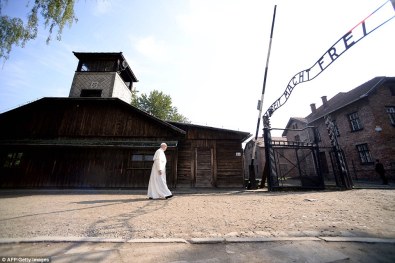 You may be aware that World Youth Day is occurring in Krakow, Poland. World Youth Day is a gathering of the Church’s youth and young adults for days of catechesis, worship and prayer. The event culminates on Sunday with a Papal Mass. Pope Francis is in Krakow with the world’s young people. I have been viewing different images via social media from the gathering but what has struck me most is a six minute video of Pope Francis visiting the concentration camp at Auschwitz and taking some private moments of prayer in the cell which housed St. Maximillian Kolbe before his death. St. Maximillian Kolbe was a Catholic priest who volunteered his own life in order to let another prisoner live who was a husband and father. The video, which is all in silence, is almost surreal. (I have posted the video on our parish Facebook page.)
 Pope Francis arrives simply at the cell as is his wont. He first peers into the darkened cell then steps in. A chair is brought in and the Holy Father sits and we are given this amazing image of the successor to St. Peter clad in white sitting in a darkened cell with his head bowed in prayer in this place of unimaginable horror.
 “Who do the crowds say that I am?” “Who do you say that I am?” These questions of our Lord have continued down through history ever since he first asked them to that small group of followers. Every age has to pick up the question and find the answer. Every disciple has to answer the question and, I think, even in the life of disciple the answer shifts as we come to know more and more who Jesus is. (I know that it has for me.)
 There are two scenes in the movie “Risen” that build upon one another. Both scenes involve the Roman tribune Clavius who has been assigned to investigate the empty tomb of Christ.
