
Tags
Charity, Christian life, Church, discipleship, mercy, resurrection, trust

Jesus Christ appears on the Shore of the Lake of Tiberias by James Tissot
It is interesting to note how the disciples react in the gospels when they encounter the risen Lord. They all have this very interesting reaction of a mix of great joy and amazement but also fear and uncertainty. They rejoice that Jesus is risen and alive but yet they remain locked behind closed doors out of fear of the religious authorities. The tomb is emptied yet they know that the powers of the world are seeking to persecute and destroy them because they are the followers of this Jesus of Nazareth. It was true for the first group of followers and it remains true today.
It is also interesting to note how the risen Lord responds to this mix of emotions on the part of his followers. He does not respond by given them a blueprint or map if you will. The risen Lord in all of these encounters never tells them how things will go or what will happen, how they will witness to him or where it will take them rather all that he continually says is to rejoice in the resurrection and to trust in him.
A scene from the movie “Risen” has remained with me these past few weeks. In the movie the Roman tribune at the center of the story has seen the risen Lord and his world is turned upside down. He is following along with the disciples and at one point he is with them as they are rushing to Galilee because Mary Magdalene had told the disciples that Jesus had said he would be there waiting for them. The tribune is running alongside Peter and they both stop to catch a breath. The tribune asks Peter what he thinks they will find in Galilee and Peter says, “I don’t know.” Perplexed by this, the tribune then asks him why he is going if he does not know what they will find and Peter responds, “Because I trust.”
Those first disciples, when all the powers of the world were arrayed against them, had nothing other than joy and amazement at the resurrection and trust. It was enough for them and frankly, it is enough for us. We also have the joy of the risen Lord in our hearts yet we also know fear and uncertainty. We also do not know where it is all going. There are also powers arrayed against us. Christ does not give any one of us a blueprint or a map; rather he gives us some things much more worthwhile – his very resurrection and the call to trust in him.
We find in this Sunday’s gospel (Jn. 21:1-19) that there are also two other things given to aid the disciples in their journey throughout history. One is community – the Church. The disciples are gathered together again at the Sea of Tiberias and this is not just coincidence. Peter says that he is going fishing and the others respond that they will go with him. Together, they all get in the boat. Scriptures tells us that where two or three are gathered together, there is our Lord in their midst. It is when they are together and all of them hard at the work of fishing that our Lord appears to them. The life of Christian faith is not meant to be lived alone. We encounter the risen Lord together. Community and the Church are not optional for the Christian, rather they are a source of encounter with the risen Lord.
The other great gift given to the Church in this gospel and a continual way to encounter the risen Lord is the call to charity. Three times our Lord asks Peter if he loves him. Three times Peter says “yes” and the risen Lord responds with, “feed my lambs … tend my sheep … feed my sheep.” It is a call given to the whole Church. It is also a gift. When we feed and tend one another, especially the most vulnerable and poor in our midst, then we meet the risen Lord and we are graced and strengthened in our encounter. The powers of the world do not understand this and they never will but there is a great power, perhaps the greatest, given to the poor and the vulnerable. When we live charity, we encounter the risen Lord.
As for the first disciples so for us, we know the joy of the resurrection yet we also can be fearful and uncertain in our world. The risen Lord does not give a blueprint of how it will all work out. Rather, he invites us to live in the joy of the resurrection and to trust in him and he teaches us that we will encounter him in community and in the living of charity.
 There are many images of ordained priesthood that operate in our Church today – the priest as sacramental minister, the priest as co-worker with the bishop, the priest as pastor, the priest as leader of the worshipping community. These are some of the more “official” images of priesthood but there are others, I have come to realize, that can often operate in the hearts and minds of both priests and laity alike. The priest as administrator and builder operating the parish with efficient ease! The priest as superhero stomping out evil with his superpowers. (I have seen many a vocation poster/image along this line and I have to admit I find it rather silly to say the least.) The priest as shaman battling dark forces behind the scenes by the use of ancient languages and rituals. The priest as philosopher or wisdom figure enlightening the masses with his erudite thought. Are there times when a priest does have to head a building project and administrate a parish? Yes, certainly. There are also times when a priest has to wade through the darkness of sin and evil in life and I hope that at least every now and then the priest does offer something worthwhile for people to consider. All this is to say that there are many images surrounding the priest – some official and some not-so-official yet held in different hearts.
 A friend of mine in the Community of Sant’Egidio has asked me to reflect upon this past Holy Week and Easter Sunday in the parish and how the community accompanied the parish in its celebration.
 At the end of Luke’s gospel (Lk. 24:1-12), once the women had shared with the disciples what had occurred at the tomb, we are told that Peter runs to the tomb and upon arriving he bends down and sees “the burial cloths alone”. It seems an almost inconsequential thing. The main fact is the empty tomb, right? The burial cloths are just an after-thought one might think. John, in his gospel, is even more precise – the burial cloths are also noted but then John shares that the cloth used to cover the head of Christ was rolled up in a separate place.
 So much of the Christian life seems to be about “going out”. We are called to go out to proclaim the good news. We go out to share Christ’s love. We go out to serve others. This is good and authentic to our faith and it is the mandate that Christ has given us as Church to proclaim the good news to the ends of the earth.
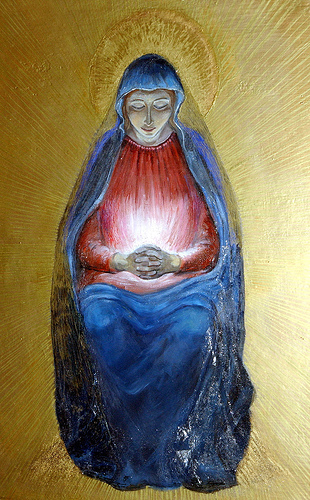 Two things struck me as I prayed over the gospel this past week. The first is when Luke tells us that Mary entered the house of Zechariah and greeted Elizabeth. I found myself returning again and again to that scene in my imagination. How joy-filled it must have been! Mary stepping into this house which for too long had been barren of the sound of new life, the sound of children. Elizabeth said that the child in her womb leapt for joy at the sound of Mary’s greeting – a confirmation of what the angel had promised Zechariah. What was thought barren will now bring forth life and it will be a life that, in turn, will proclaim the coming of the Messiah! For nothing is impossible to God.
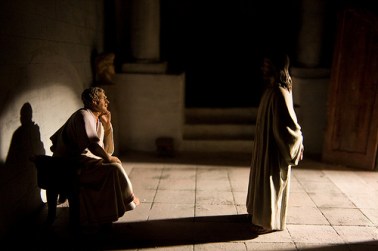 At one point in his commentary on this Sunday’s Responsorial Psalm (Ps. 93), St. Augustine shares this observation: Humble people are like rock. Rock is something you look down on, but it is solid. What about the proud? They are like smoke; they may be rising high, but they vanish as they rise.


 The Alternate Path