
 Recently the Knights of Columbus decided to begin an initiative to help refugees at the U.S. – Mexican border. Carl Anderson, the Supreme Knight of the Knights of Columbus, specified in his announcement that this was not a “political statement” but a statement of principle. I find it telling that the head of this fraternal, international Catholic organization guided by the tenets of the Catholic faith felt it necessary to make this distinction.
It was in seminary that I first heard the term “meta-narrative” (beyond-story) and it was in reference to God’s plan of salvation being the meta-narrative to all other narratives in human history. The meta-narrative is the one overarching narrative (the beyond-story) to which all other narratives are to be measured, judged, transformed and even discarded if necessary. Prevailing ideas and societal customs, histories of peoples and nations, economic and political systems are all narratives and may indeed have much positive to speak for them but none are the meta-narrative, none are the Gospel story of God’s movement and plan in history. All narratives are to be judged in the light of the meta-narrative on God’s work of salvation.
I would propose for consideration that Carl Anderson’s need to clarify the purpose of the Knight’s new initiative at the border witnesses to the fact that for many who claim the name of Christian the narrative of U.S. politics has eclipsed the meta-narrative of the Gospel message. Everything is being viewed and evaluated through the lens of contemporary American politics regardless of the side of the aisle you fall on.
How did this happen? This is not an exhaustive list but here are some thoughts. The 24-hour, 7 day a week news cycle – now even more magnified by social media. We have always had political junkies and that is okay. We need people who are passionately invested in politics and willing to work and fight for what they value but what is different today is that we now have political junkies debating political junkies nonstop on our tv screens both in our homes and all other type of screens. What we are being taught by this continuous stream of political junkie debate (no matter where we find ourselves on any particular issue in the moment) is that this is the only legitimate way to see and judge all actions and events – only through the lens of the political. Holding to the meta-narrative of the Gospel, I would say “no”- politics is not the only way to see and evaluate everything and that assumption is itself a false narrative.
The turn to the base. I am not a political junkie, nor care to be – thank you. But what I have learned through my own being immersed in the continuous stream of political junkie-ism is that not that long ago a decision was made to turn to the base in the effort to win elections and advance causes and perspectives. This was a shift away from a broad appeal that would attract the large number of votes needed to get elected. It has proven to be an effective strategy but it is a strategy based on a negative – the apparent apathy of the majority vs. the fervor of the base. Because it is based on a negative, I believe it is doomed to collapse at some point and it may be quite ugly when it happens. For our purpose here, the turn to the base is again the turn to a segment of the population who is already keyed into things political – the people who have bought into the notion that politics alone is the best means to achieving a certain desired end. But, again, it is the politically-minded crowd who are having the overarching influence on determining how things are being viewed, evaluated and presented.
I do not want to come across as denigrating politics. There is certainly a value and even a virtue to politics and it is a way of encountering the mystery of life and even the true meta-narrative of God’s work of salvation but it is not the only way. I would hold that those people who are not so keyed into the political are encountering the mystery of life and even the true meta-narrative in their own way which is just as valid – art, literature, relationships, responsibilities, worship, service, appreciation of creation, community … the list could go on.
Fear. U.S. society is changing and there are many factors that are at work in this. There are and will be more darker tones of skin, there will be more non-European sounding names, there will be different styles of clothing than what we have been used to in American society. Get used to it; it is a demographic reality but change can be scary so in the midst of the change it is always important to remember that Scripture reminds us that “perfect love casts out all fear.” Trust that God is at work bringing about His Kingdom of all of His children in all of their varying hues, languages and experiences. By trusting a little bit more we can begin to let go of our little kingdoms in anticipation of God’s coming Kingdom. Death is also a fearful thing. The Baby Boomer generation is approaching this great mystery and no amount of commercials with gray haired people climbing mountains or couples holding hands while soaking in claw-footed bathtubs set in nature will forestall this reality that we all must face. Here is where the illusion of all narratives that try to propose themselves as the meta-narrative ultimately collapse. At the tomb. The resurrection of Christ is the only beyond-story that has ever conquered the grave. This is the only story that gives that hope which endures and that overcomes all fear.
What can be done to reduce the illusion of politics as the meta-narrative? Some thoughts. Turn off the 24 hours news cycle. It can be done and by doing so more space is allowed for other narratives and even the true meta-narrative to enter our lives. Take time to read good literature and listen to good music and enjoy good drama and theater. When good, these realities lead us into the great mysteries of the human experience. Enjoy good sport. This also is a way of being led into the mystery and drama of human experience. Remember that the United States is not the center of the world. I love my home country and am proud of what we have achieved but I have travelled enough to recognize that not everyone is looking to the U.S. at all times and that there is beauty and truth in all cultures. (A little humility goes a long way.) Go into a situation where you are a minority and be willing to keep going there. Pray and worship – root yourself in the true meta-narrative of the Gospel and even encounter the Author of this beyond-story. Go for a walk in creation and allow yourself to be struck by the truth that each of us is just one part of something much bigger than ourselves. Serve other people and learn to recognize God in that space of service. Make friends with people you do not necessarily agree with on everything. Cultivate wonder and curiosity in your life.
And, yes, be involved in politics if you have that desire but please recognize it for what it is – just one part of the story and not the whole.
Truth is, this reflection will probably be judged, written off as naïve or possibly even condemned by people who view all things through the lens of politics. Okay, that is your choice but it does not have to be mine. To God be the glory.
 In a recent interview on the life of faith and discipleship, Pope Francis shared an expression often used in Argentina – the expression is “primerea”. “…the Lord ‘primerea,’ anticipates us, waits for us; we sin and He is waiting to forgive us. He is waiting to welcome us, to give us His love, and each time faith grows.”
 What was our Lord writing on the ground with his finger? No one really knows but it is an interesting addition that the gospel writer makes to this narrative and it does lead one to wonder. What was he tracing on the ground?
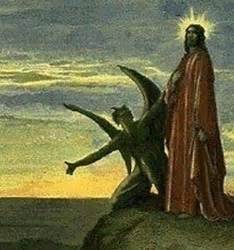 Have you ever noticed that each of our Lord’s temptations in Luke’s Gospel is a temptation to something within the immediate and that our Lord responds to each temptation by his hope in the future? That Jesus responds by not getting stuck in the immediate but by looking beyond the immediate to the infinite?
 “What does discipleship look like?’’ This was a question we were asked again and again in theology studies. What does it look like? How do disciples act in the world? How does one show that he or she is a follower of Christ?
 I go to the YMCA to exercise and for anyone who has been there you know that once you enter the building and head down the main hall there is a lounge area on the left and on a table in this room there is always a puzzle being worked on. I have begun the practice of spending three to five minutes at this puzzle after I exercise and before I leave. My goal is to try to get at least one piece of the puzzle in place. (The last time I was there I got three pieces in … I was quite proud of myself!) I could easily spend hours at this table because I like puzzles but I am learning that there is something good about limiting myself to just one or a few pieces at a time and also seeing how the puzzle comes together as other people also work on it.
 As some of you know I recently went to Yellowstone National Park and led a retreat there. Before and after the retreat I had free days so I took advantage of those days and went on some hikes. The first day going in I stopped at the ranger station just to check on things and make sure there were no concerns about the trails I was considering. The ranger suggested that I download the Yellowstone Park app as it would be a help to me. I took his advice and downloaded the app. It was a great help. What they have done at Yellowstone (and I am not sure if this is at other parks or not) is that they have mapped out every trail in the park on this app. Not only that, but when you go out on the trail you take your phone with you, switch it to airplane mode so that it is not continually searching for coverage and draining your battery and with GPS the phone shows you via a little dot on the screen exactly where you are at on the trail. One phone in the vast expanse of Yellowstone communicating with some satellite in the sky telling you exactly where you are at and which way to turn when the trail splits. I just find that level of technology, connection and focus amazing!
 A joke – an elderly couple were visiting the county fair. While wandering around they noticed that helicopter rides were being offered for fifty dollars. The wife turned to the husband and excitedly said, “Let’s go on a helicopter ride!” The old man just shook his head and replied, “Honey, that’s a lot of money. Fifty dollars is fifty dollars.” and they walked off. The next year the same couple was back at the fair and again helicopter rides were being offered for fifty dollars. The woman wanted to go for a ride but again her husband just shook his head and said, “Sorry, fifty dollars is fifty dollars.” The woman sighed and the old couple walked off. The next year, they were again back at the fair and again helicopter rides were being offered. Again the wife asked her husband to go up on a ride but again the man answered “Fifty dollars is fifty dollars.” This time though the pilot was nearby and overheard their conversation. He stopped the couple and said, “Listen, I will make you a deal. I will take you up and give you the best and most thrilling helicopter ride of your lives and if I hear not a single thing from you – no words, no laughing, no exclamations – your ride will be free!” The old man – always quick to get something for nothing – immediately said yes and up the three went in the helicopter! The pilot was true to his word – it was the best and most thrilling helicopter ride! The day was beautiful and you could see for miles! The pilot, to add a little excitement (and try to get some sound out of the two) even steeply banked the helicopter one way and then the other way throughout the ride. The pilot was amazed though because throughout the whole ride he heard not one sound from the elderly couple. Finally, after landing he turned around and realized that the old man was not in the helicopter. “Where is your husband?” he asked the woman. “Oh, he fell out about thirty minutes ago.” Shocked, the pilot asked, “Why didn’t you say something?!”. “Well,” she said, “fifty dollars is fifty dollars!”
 Mary Lou was a woman I came to know in a previous assignment. She has since passed away. May she rest in peace. Mary Lou was one of those people who had the gift and (I think) the discipline of hospitality. Whether she was receiving one guest for a simple visit or a party of fifteen for a dinner, she knew how to welcome people, put them at ease and (in a good sense, never overbearing) see that their needs were met. I think that she saw hospitality as a holy act – a way of discovering and acknowledging the good in the other person. When you left Mary Lou’s house you were nourished on a multitude of levels.
 (This homily is geared toward our parish “Growing in Faith Day”. It focuses on the gifts of community, faith and the Eucharist.)
 The Alternate Path