
• About The Alternate Path

The Alternate Path

~ Thoughts on Walking the Path of Christian Discipleship

The Alternate Path

Tag Archives: Jesus

The God who tramples the waves of the sea.

12 Saturday Aug 2017

Posted by mcummins2172 in homily, Uncategorized

≈ Leave a comment

Tags

Christianity, faith, God the Son, Jesus, Jesus walking on water


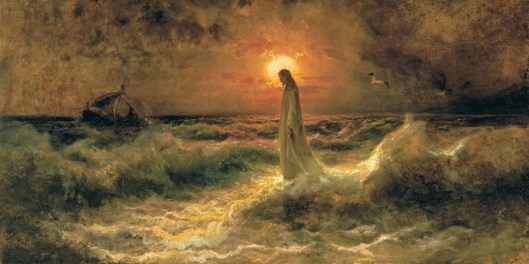
Julius Sergius von Klever Tutt'Art@ (36)

“Jesus Walking on the Water” by Julius Sergius von Klever


Matthew’s presentation of the occurrence of Jesus walking on the water (Mt. 14:22-33) is not about showing Jesus as someone with magical or superhuman powers but rather about showing Jesus as the one who can do what God alone does.

Matthew, fully conversant with the Hebrew Scriptures, knows the connections and they are alluded to in his telling of this miracle. In the ninth chapter of the Book of Job (9:8), we hear that it is God “who alone stretched out the heavens and trampled the waves of the sea.” Here we find Jesus walking calmly on the water, trampling the waves of the sea. In Psalm 144:7 we hear the cry of the creature before the Creator, “Stretch forth thy hand from on high, rescue me and deliver me from the many waters.” Here, Peter having taken some steps in faith becomes fearful, he begins to sink and he cries out, “Lord, save me!” We are then told that Jesus immediately “stretched out his hand,” took hold of him and lifted Peter to safety. God alone is the one who can stretch forth his hand and rescue us from the waters that threaten to drown us!

There is a third connection, I believe, and it is from the first reading (1 Kings 19:9a, 11-13a). Elijah, the prophet, is told to go outside because God is passing by. There is a strong and heavy wind but God is not in the wind. There is an earthquake but God is not in the earthquake. There is a burning fire full of fury but God is not in the fire. Finally, after all this, there is a tiny whispering sound and the prophet hides his face because he knows that now God is passing by. In the Gospel, the wind is rolling and the waves are crashing but God is not found in this tumult and chaos rather, quietly and calmly Jesus walks on the water. Christ (who does that which only God can do) neither fears nor needs the tumult and power of the forces of the world to make his presence known because he is the Lord of Life and all creation bows before him. The “tiny, whispering sound” which underlies all things and all creation is the full grandeur of God!

Our lives and the tumult of our world can get chaotic and overwhelming. God is not in the strong wind because God is more than the wind. God is not in the waters that threaten, that can overwhelm us, because God tramples on the waters.

Matthew, in his Gospel, is making use of this occurrence of Jesus walking on the water, to say something utterly unique about Jesus. Jesus is not just another mystic or guru and neither is he a person with magical or superhuman powers because none of these figures would be able to trample the waters because none of them would be more than the waters. Jesus does what only God can do. Jesus is beyond the tempests of life and creation precisely because he is the Lord and Author of Life! And the Author of Life is also the Lord of Mercy! Jesus, who does what only God can do, tramples on the waves of the sea and he stretches out his hand to save us even as the waves threaten to overwhelm. “Lord, save me!” is the only authentic cry of the creature before the Creator and Savior.

“Father, I thank you for hearing me.”

02 Sunday Apr 2017

Posted by mcummins2172 in homily, Uncategorized

≈ Leave a comment

Tags

Catholic Church, Catholic faith, Christianity, faith, God the Father, Jesus, raising of Lazarus

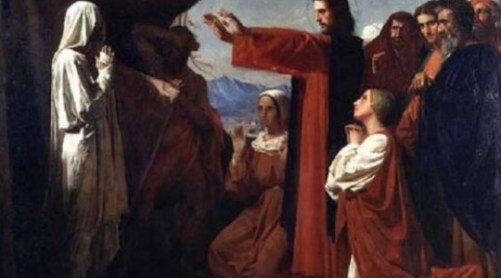
Jesus-Raises-Lazarus-from-the-Dead-540x300There is almost an ordinariness to the way our Lord goes about his mission of proclaiming and living God’s Kingdom.  Even his miracles and the raising of his friend Lazarus are not exceptions.  Our Lord takes his time in getting to the scene of Lazarus’ illness and death.  He takes time in speaking with both Martha and Mary.  Arriving at the tomb he asks that the stone be rolled back.  He addresses the Father and then, with a loud voice, cries, “Lazarus, come out!”  The once-dead man walks out. 

There are no flashes of light or rolling thunder.  Our Lord does not need to make strange incantations or weave any sort of spell.  He does not even seem to have to fast in preparation for such an extraordinary thing.  There is no burning of incense or sacrifices offered.  Jesus simply gives honor to the Father, calls Lazarus forth and his friend is restored to life.  

This is not a feat of our Lord’s own will at work.  Jesus is not a comic book superhero saving the world through his own strength and determination nor is he a wizard overcoming by his own intellect and perseverance (a.k.a., “will to power”).  Scripture tells us that Christ let go of his own glory and power and took on the form of a slave.  The salvation won through Christ is through the “letting-go” of the divinity which allows the humanity to live in full relationship of love and trust with the Father.  Jesus tells us that he can do nothing apart from the Father.  Jesus does not heal, or feed the multitude, or cast out demons or walk on water or raise the dead through his own, independent and isolated exercise of will but through his relationship with the Father.  Therefore he does not need the trappings of the superhero or of esoteric magic.  It is all through relationship and relationship is often one of the most ordinary of things. 

St. Paul in his letter to the Romans reminds us that we also have been invited into this relationship.  “But you are not in the flesh; on the contrary, you are in the spirit, if only the Spirit of God dwells in you.  Whoever does not have the Spirit of Christ does not belong to him.  But if Christ is in you, although the body is dead because of sin, the spirit is alive because of righteousness.  If the Spirit of the One who raised Jesus from the dead dwells in you, the One who raised Christ from the dead will give life to your mortal bodies also, through his Spirit dwelling in you.”  (Rom. 8:8-11) 

How often and how easily we overlook the grace we have been given, that is indeed active within us!  We easily we get lost in the noise and distractions of our world.  The Spirit of the One who raised Christ from the dead has been given us and dwells within us – giving life and transforming us.  God does not need the trappings of the extraordinary to accomplish his purpose.  The sacraments are a prime example of this.  Water, bread, wine, oil, the words of the priest, the love of a couple – yet underneath the ordinary divine grace, relationship and life is found and given.  

We should not disdain the ordinary and the grace and new life found there.  Just as Christ emptied himself of glory and held to his relationship with the Father so should we.  Life is not found in our control, our ego, our own little “wills to power”, living within our own little bubbles.  Life, salvation, healing, grace is found through relationship – recognizing God’s presence given and within and seeking to live always in the amazing ordinariness of that relationship. 

“Father, I thank you for hearing me.  I know that you always hear me; but because of the crowd here I have said this, that they may believe that you sent me.”


“Arrival” and catching the language of God.

03 Saturday Dec 2016

Posted by mcummins2172 in Uncategorized

≈ 2 Comments

Tags

Arrival, Christian life, Christianity, faith, Jesus, Kingdom of God

arrivalThis last week I saw the movie “Arrival”.  I found the movie to be very thought-provoking.  I do not want to ruin the movie for anyone so I will not delve too deeply into the story but the heart of the movie is about language, thought and even time.  The movie asks a simple question; “If aliens arrived on earth how would we communicate?”  Especially if the aliens were so different physiologically from us and did not communicate by sound as we do.  The movie centers on a  translator and her work to overcome this barrier.  At one point in the movie there is a discussion about how learning another language might actually effect and even change a person’s way of thinking.  Learning a new language helps us to think differently and to see the world differently.  
In biblical thought, a prophet is not a fortune-teller or someone who can somehow magically tell what is going to happen in the future.  Rather, a biblical prophet is someone who lives a deep relationship with God and who is able to read the signs of the times from that perspective.  To make use of the discussion in the movie – a prophet is someone who has caught a bit of the language of God and is able therefore to think differently and to see the world differently.  A prophet is someone who begins to see as God sees and to dream as God dreams.  

In today’s gospel (Mt. 3:1-12) we are given the figure of John the Baptist.  The man whom Christ himself called the greatest of prophets.  John is this uniquely charismatic figure drawing huge crowds from all over Jerusalem, Judea and the whole region around the Jordan.  He proclaims the coming Kingdom of God and he calls his listeners to repentance.  Almost as if to provide a contrast, the gospel brings the Pharisees and Sadducees into the picture.  They approach the baptism of John not as a true spirit of repentance but because it looks good before the crowd who they knew held John in high regard.  John’s eyes were on the promise of eternity and the mercy of God because he had caught the language of God while the eyes of these religious authorities were only on what looked good in the moment and what would seem pleasing to others.  John’s eyes were on the ever new possibility of the Kingdom of God precisely because he had caught the language of God. 

We could say that John already saw and set his life by the vision offered by the prophet Isaiah in the first reading (Is. 11:1-10).  John saw that day when the one would come on whom the spirit of the Lord would rest and who would judge rightly and who would strike the ruthless and bring forth justice and through whom the wolf and the lamb would be guest of one another.  In the Jordan River, John would baptize the one who is himself the incarnate Word of the Father. 

In Christ, the language of God is fully revealed and spoken and it overcomes all the sad divisions of our world.  Isaiah’s poetic use of imagery is all about the divisions and fears and animosities of life being overcome – “the cow and the bear shall be neighbors … the baby shall play by the cobras den …” – all this shall occur through Christ. 

And it continues through his body, the Church.  In Christ the role of the prophet is not ended, it is multiplied infinitely!  Through our baptisms we are all called to be prophets!  In the Eucharistic Prayer entitled, “Jesus, the Way to the Father” we find these words, “Grant that all the faithful of the Church, looking into the signs of the times by the light of faith, may constantly devote themselves to the service of the Gospel.” 

To be a prophet is not to somehow magically see into the future but to live in deep relationship with God and to read the signs of the times from that perspective.  The prophet learns the language of God fully revealed in Christ.  The prophet allows that language to change his or her own pattern of thought and the prophet lives by the ever new possibility of God’s Kingdom which says that all the sad divisions of our world and our individual lives can be healed and can be overcome.  

To learn a language changes the way we think.  The prophets caught the language of God, John learned it and even baptized the Word incarnate and, now, the Word is given and spoken to us. 

We can live differently.  We can live through the very Word given to us as God intends.

That which endures

12 Saturday Nov 2016

Posted by mcummins2172 in homily, Uncategorized

≈ Leave a comment

Tags

Catholic Church, Christian life, Christianity, discipleship, faith, hope, Jesus

church-destroyed-by-earthquakeScholars suggest that by the time Luke composed his gospel the temple had already been destroyed.  This grand edifice, seemingly unmovable, adorned with costly stones that people were admiring in this passage was, by the time of Luke setting quill to parchment, just a heap of ruins.  It demonstrates how quickly things can change and also how little we really know about what will happen tomorrow.  We like to think we are in charge … but we are not.

Using the temple’s destruction and our Lord’s prophesying of that even as a springboard; today’s gospel (Lk. 21:5-19) invites us to go deep in the spiritual life.

There are levels to the spiritual life.  Saints and mystics throughout the Church’s history testify to this.  The first level and most basic is a level often caught up with outer things.  The grandeur of a temple, the use of precious stones, only a certain style of music or liturgy in worship, only this type of devotional practice or prayer.  Is there a value to the beauty of a church or worship or prayer?  Certainly, that is not being denied but all of these exist in order to usher one into an encounter with the Divine.  If they themselves become the focus then something is off-kilter.  As a friend of mine once said, there is always the temptation to major in the minors.

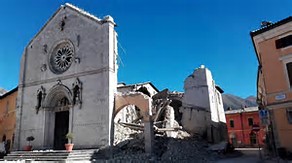
We have all heard of the recent earthquakes that have hit Italy.  In one of these earthquakes a beautiful church connected to St. Benedict completed collapsed.  A picture I saw just had the front façade standing with all else behind it flattened out.  Miraculously no person was killed when this happened.  What I found inspiring was that as soon as the monks and nuns of the community whose church has been destroyed determined that everyone in their community was accounted for they went out into the larger area and began to minister to others in need – helping physically to dig people out of the rubble and also bringing the sacraments to people.  They did this because they were rooted in something deeper than a building (an external).

The deeper reality our Lord is inviting each of us to in the journey of faith is relationship with him.  There will be false predictions that the end is upon us, nation will rise against nation, and there will be earthquakes, famines, plagues and signs in the sky.  These are all shifts in the greater turning of human history but there will also be personal shifts and turmoil.  People will be led before kings, governors and all the different powers of the world and our lives.  Families will be split and there will not be understanding.  Christians will be hated.  Yet in the midst of all this foretold turmoil of the history of our world and our own personal histories, our Lord – the one who foretold the destruction of the temple – says this, “Remember, you are not to prepare your defense beforehand, for I myself shall give you a wisdom in speaking that all your adversaries will be powerless to resist or refute.”  

“…for I myself shall give you a wisdom in speaking…”  The truth implied here in the midst of all the turmoils that this life brings is a living relationship with Christ.  Remaining on the level of the external spiritually – while not really knowing the Lord or allowing him to know us – will not cut it when life gets tumultuous.  In all seasons of life the Christian must root him or herself in relationship with Christ.  Only in this relationship can be found the wisdom and perseverance that we need in life.

Our Lord listened as people who had no idea of what tomorrow would bring spoke admiringly of the temple.  He asked them to move beyond the external to that which truly lasts.  He asks us to do the same – to trust in him and to find life.

A God and a community who seek out

10 Saturday Sep 2016

Posted by mcummins2172 in Uncategorized

≈ 1 Comment

Tags

Christian life, Christianity, discipleship, faith, hope, Jesus, mercy, The Good Shepherd, Year of Mercy

good-shepherdOne of the truths revealed in today’s gospel (Lk. 15:1-10) is that our God is not a God content to let people remain anonymous.  The shepherd goes out in search of the lost sheep because that one sheep truly matters to him.  The woman turns the house over searching for the lost coin because that coin is of real concern to her.  We are of concern to God.  We are not alone in a vast universe governed by random chance.  We do not have a God who does not care.  God is willing to seek each one of us out, willing to even enter the darkness of sin and death, to find us and then rejoice in the finding!
But this truth also applies to us who are called to be God’s people in our world.  The Christian community is not meant to be an anonymous collection of individuals made up of people without names and without love – separate and alone.  Because we have been loved by God and sought out by God we must, in turn, strive to love as God loves and seek out as God seeks out.  The community Jesus calls us to is not one of anonymous and separate persons but of brothers and sisters who know each other by name.  Friendship and care must be at the heart of the Christian community but it needs to be noted that this friendship is not of our own doing or crafting.  The friendship of the Christian community flows out of Jesus’ own call to his disciples and obedience to his Word.  The origin of friendship in the Christian community is in God himself.  This is a great mystery and it is a mystery we are called to live and it is a mystery we proclaim in front of a world that seems so intent on reducing the full dignity of the human person to just a caricature of the anonymous individual.

Every person has a name.  Every person has a worth.  Every person is valued and sought out by God.  No one is left behind.  We need to live this friendship of Christ as Church and, by so doing, witness to our world.  For a Christian community to have the most beautiful sanctuary or the most active list of ministries without this friendship that seeks out is (to paraphrase St. Paul and our Lord himself) to be just a noisy gong, a clashing cymbal and even a whitewashed tomb.  No life is ultimately produced.

The identity of the Church is not found by remaining within but is realized in mission.  It has been this way from the very beginning with the outpouring of the Holy Spirit and the call to proclaim the good news to the ends of the world!  We each have a name given by God and a task given by God, we only become who we are meant to be as we live the task we have been given.  The Christian community only becomes who she is meant to be when she lives the friendship she has been given by Christ.

This friendship begins within the Christian community herself and then it goes out into the world.  We must seek out one another.  We must be of concern to one another.  In order to be true to the gift that we were given (meaning being sought out by God himself), we cannot remain content in just being a collection of anonymous individuals.  When we meet one another in the friendship of Christ we learn we can even look out on the multitudes of our world and see not just anonymous individuals who threaten my space and my freedom but brothers and sisters and the multitudes of people who are alone and suffering learn that they are in fact not alone and that there is a God and a people who seek to care and who seek to know their name.

Pentecost – we have a part to play

15 Sunday May 2016

Posted by mcummins2172 in homily, Uncategorized

≈ Leave a comment

Tags

Christian life, Christianity, discipleship, Holy Spirit, Jesus, Pentecost, Virgin Mary

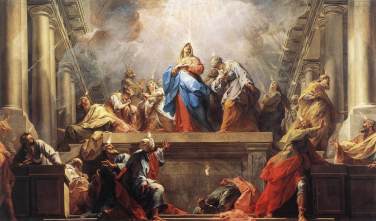
PentecostIn looking at my Facebook feed this weekend I have been reminded that we are in the midst of graduation season. Picture after picture of smiling graduates, at all levels, all across the country…  We certainly celebrate with graduates and congratulate them on what they have achieved.  But it is worthwhile to also note that behind every graduate stands dedicated teachers – men and women who often selflessly work for the good of their students.

I have recognized that one of the greatest gifts I have known in my life is that I have had exceptional teachers.  I have been blessed with men and women who have challenged and inspired me from elementary school all the way through my study of theology.  I owe to them so much – more than I can ever repay.  They guided my learning and also taught me how to keep learning.

But here is the catch – a teacher (even the very best teacher) can only instruct if the student is willing to listen. The student has a role to play.  The student must understand that he or she has a lack, that he or she does not have full knowledge, that he or she has something to learn and maybe even does not know what he or she does not know.  A student has to be open and willing to receive.  A student needs to be humble.

If today’s gospel (Jn. 14:15-16, 23b-25) sounds familiar it is because part of it was proclaimed last Sunday. Last Sunday I choose to focus on the Father and Son coming to dwell with the believer in friendship.  This Sunday, being Pentecost, it is appropriate I believe to focus on these words offered by our Lord, “I have told you this while I am with you. The Advocate, the Holy Spirit that the Father will send in my name, he will teach you everything and remind you of all that I told you.”  

One of the roles of the Holy Spirit is to teach but a teacher (even the very best) can only instruct if the student is willing to listen, if the student recognizes that he or she has a lack and if the student is humble and willing to receive. On Pentecost we proclaim and celebrate the coming of the Holy Spirit upon the disciples but the coming of the Spirit did not end there.  If this celebration is to be authentic then we, on our part, must be willing to ask the question, “Am I willing to listen and then receive the gift of the Spirit and the Spirit’s instruction for me?”  I have to be humble enough to acknowledge my need and my lack and then I have to be faith-filled enough to accept what the Holy Spirit has to give.

That day of Pentecost the gathering of disciples was so little, so small in such a big world. The Holy Spirit comes upon them like a strong driving wind and they begin to proclaim the good news!  Acts lists a multitude of nations and peoples present and then we are told that each nation and grouping heard the disciples proclaiming in their own tongue.  To this small, little gathering of disciples God gives nothing less than the whole world!  We have a part to play on Pentecost.  We have to be faith-filled enough to accept what the Holy Spirit has to give us!

Lord, may we not be so stingy and little of heart as to begrudge your call. Playing small is not part of Pentecost.  It is a false humility.

Pentecost is considered the birthday of the Church and on this birthday we find two things – the outpouring of the Holy Spirit and the small gathering of disciples in prayer, listening and fully aware of their need. How do we learn how to listen?  In any age the skill of listening is needed but I believe now, even more, this skill is needed in our lives and in our world.  How do we learn how to listen?

Here is one simple thought. Scripture testifies that there is only one person who was present at the birth of Christ, who was present at the crucifixion and who was present at Pentecost.  One person – Mary, the mother of our Lord.  To learn how to listen and then have the faith to say “yes” go to Mary.  Seek her out in Scripture, seek her out in prayer.  Ask her to pray for you and to pray with you.  She will teach if we are willing to listen.

A teacher can only instruct if the student is willing to listen. We have a part to play on Pentecost.  We need to listen and we need to have the faith to say “yes” to the Holy Spirit.

The abandoned burial cloths

26 Saturday Mar 2016

Posted by mcummins2172 in Easter Sunday, Uncategorized

≈ Leave a comment

Tags

Christian life, Easter, empty tomb, Jesus, resurrection

empty_tombAt the end of Luke’s gospel (Lk. 24:1-12), once the women had shared with the disciples what had occurred at the tomb, we are told that Peter runs to the tomb and upon arriving he bends down and sees “the burial cloths alone”. It seems an almost inconsequential thing.  The main fact is the empty tomb, right?  The burial cloths are just an after-thought one might think.  John, in his gospel, is even more precise – the burial cloths are also noted but then John shares that the cloth used to cover the head of Christ was rolled up in a separate place.

In the eleventh chapter of John’s gospel we find the story of the raising of Lazarus. Jesus arrives at the tomb of his friend who has now been dead for four days.  Jesus commands that the stone be removed and then he cries with a loud voice, “Lazarus, come out.” John 11:44 reads this way; “The dead man came out, his hands and feet bound with bandages, and his head wrapped with a cloth. Jesus said to them, ‘Unbind him, and let him go.’”  

Lazarus emerges from the tomb still wrapped in the cloths of death because he is raised back to a life that is still bound by mortality. He will one day die again.  In the empty tomb of Christ, the burial cloths have been left behind because Christ has been raised to newness of life.  He who once was dead now lives forever!  Death no longer has power over him!

Our God is a God of life and not of death. Guided by the Spirit we can now read this throughout salvation history.  God created everything and all life out of the sheer gratuity and abundance of his love.  God looks upon his creation and proclaims it to be good!  When the people of Israel were enslaved God heard their cry.  God freed them from their slavery and led them into the new life of their own land and their covenant with him.  The prophets, again and again, call the people back to true life that can only be found in relationship with God.  Even when the people profaned the covenant and the very name of God, God promises that he will restore them and cleanse them for the sake of his own holy name.  God cannot be other than God.  John tells us that “God is love” and Pope Francis asks us all to recognize this holy year that the name of God is mercy.

Through the prophet Ezekiel, God promises that not only will he cleanse us outwardly but, even more so, that he will give us a new heart and a new spirit and that he will take from us our stony hearts and give us natural hearts.

In the empty tomb of Christ, with the burial cloths discarded and left behind, God removes our stony hearts. In the very place of death and decay, God gives us a new heart and a new spirit!  Our God is a God of life and not death.

The new heart and new spirit of the Christian flows from the empty tomb of Christ and this new heart has already begun beating! Our resurrection to new life has already begun.  St. Paul (and all the saints by their very lives) remind us that through our baptisms we have died with Christ in order to rise to newness of life with him.  We now live for God in Christ Jesus!

In Christ, the tomb is emptied and the cloths of burial are left behind. Now, we, in Christ, can leave behind the life-denying cloths that bind us and all of humanity – the burial cloths of sin, violence, arrogance, egocentrism, injustice, isolation and fear.  In Christ, we have risen to newness of life!  In Christ, we can live again for one another and for God!  Death is not the final word!  Newness of life in Christ flows out of the empty and defeated tomb.

The tomb is emptied. The cloths that bind are left behind.  Christ is risen!  We are given a new heart and we can now live in newness of life!

Thoughts on the Sunday readings: Politicians, Jesus and Zen Foxes

12 Saturday Sep 2015

Posted by mcummins2172 in faith, homily, trust

≈ Leave a comment

Tags

Christian life, discipleship, faith, Jesus, trust

Jesus - way, truth, lifeSo … we are into the presidential primary election season. Already the news is happily swamped with politicians posturing themselves. We, for our part, keep watching and asking ourselves, “Who is the one that seems to have that presidential timber and swagger?” In light of the political climate we find ourselves in as well as this Sunday’s gospel reading, a question to be entertained is, “If Jesus were running for my party’s nomination, would I vote for him?”

Truth be told, I do not think Jesus would receive many votes in either political party but I also do not think Jesus would really care! Throughout the gospel our Lord does the one thing that a politician would never do because the politician knows it to be political suicide: Jesus never confuses the illusion of control with true leadership and true personhood. Therefore, he never needs to pretend control. Our Lord is free of this temptation.

In today’s gospel (Mk. 8:27-35) we are told that Jesus is walking with his disciples and he asks them, “Who do people say that I am?” This question, itself, sets Jesus apart from the career politician. The politician says, “Let me tell you who I am. These are my skills… This is what I have achieved…” Jesus doesn’t do that, rather he asks, “Who do people say I am … who do you say I am?” Jesus knows full well who he is and what his purpose is but he does not impose himself. Rather, he waits. He allows the Father to work in the hearts of his followers and he allows his disciples to come to him. He allows them to come to the realization of who he is. Jesus does not force his disciples’ recognition. He needs neither to control nor manipulate the situation.

Then and only then, he begins to teach them that the Son of Man must suffer, be rejected, be killed and then rise. Imagine this as a political platform! We cannot and this is why Peter’s reaction is so perfect because it is our honest, human, knee-jerk reaction! “No, Lord, this cannot be! You do not need to suffer! You do not need to be rejected! You can control the situation! You are the Christ!”

But leadership and control are not necessarily synonymous. Our Lord wants to show us a different way of both authentic leadership and personhood. “Get behind me, Satan. You are thinking not as God does, but as human beings do … whoever wishes to save his life will lose it, but whoever loses his life for my sake and that of the gospel will save it.”

Our Lord is showing us a way of living which can forego the illusion of control. Isn’t it interesting to note how so many times after our Lord performs a miracle he is quick to say to the person healed, “Your faith has made you well.”? He does not need to grasp that credit. In the fourth chapter of John’s gospel, our Lord says, “My food is to do the will of the one who sent me, and to complete his work.” (Jn. 4:34) Not my program, not my agenda, not my control but rather my Father’s will. Every moment of our Lord’s life was focused upon and directed in trust toward the Father’s will.

This letting go of the illusion of control is not a passive resignation akin to despair. It is far from that. Rather, it is the most active of stances in our world. It is learning to seek and make the choice for God’s will in all things and all situations. There is nothing passive about that. This is the one choice which can truly transform lives and the world itself!

One of my favorite social media sites is entitled ”Bored Panda Animals”. It is a site that hosts often stunning photography. Just this last week the site highlighted a photographer who captures images of foxes in the wild. These pictures are beautiful and they depict these animals completely relaxed, eyes closed, enjoying the breeze, Zen-like in their posture. The site also interviewed the photographer who shared how she is able to capture the photos of these wild animals so relaxed. “There’s a contradiction going on when it comes to capturing Zen foxes: the harder you try, the more you’ll move away from your goal. If you are too eager, an animal will sense that eagerness and will remain alert. I learned to do as foxes do, just being there and see what might happen.”

Let go of the illusion of control. It is not real. Learn to trust in the will of the Father.

Allow God to be God and trust.

“…whoever loses his life for my sake and that of the gospel will save it.”

Thoughts on the Sunday readings: “Christ crucified” (3rd Sunday of Lent – B)

07 Saturday Mar 2015

Posted by mcummins2172 in Christ, cross, Jesus, salvation

≈ Leave a comment

Tags

Christ crucified, cross, Jesus, salvation

Jesus-Christ-from-Hagia-SophiaIt has been said that when it comes to Jesus there are basically only three options to choose from: either Jesus is a madman, a lunatic (How many people throughout the centuries, struggling with sanity, have concluded that they must be God?), either he is a liar and therefore one of the most evil people of all history, someone willing to deceive generations into the belief that he is God or lastly, he actually is who he says he is.  These are the options we have to choose from and if we are to be authentic in life then at some point we must each make a choice.

For Christians it all comes down to this one person who lived nearly two thousand years ago, who was poor, who never travelled in his adult life beyond his immediate area, who did not seem to have any formal education, who preached the good news of a God of love and humility and who was put to death by the powers that be.  If you are looking for an ascetic or a yogi to follow, then do not look to Jesus, he was neither.  If you are searching for a great philosopher or guru then do not look to Jesus.  If you are looking to a man of success in order to feel validated and bask in the glow of, then do not look to Jesus.  Jesus is none of these things.  He is something totally different all together.  Jesus cannot and will not be captured and contained by any of our definitions and biases.  Jesus can only be encountered.  It is because of this truth that Paul is able to write, “…Jews demand signs and Greeks look for wisdom, but we proclaim Christ crucified…” (1 Cor. 1:22).  “Christ crucified” – these two words held together break every human presumption about God and how he operates, about what it means to be human, about life itself.  For Christians it all comes down to a person – to Christ crucified.

In his book, “The Lord” Romano Guardini writes:

God did not reveal himself merely by teaching a truth, giving us commands to which he attaches consequences, but by coming to us, personally.  His truth is himself.  And to him who hears, he gives his own strength, again himself.  To hear God means to accept him.  To believe means to accept him in truth and loyalty.  The God we believe in is the God who “comes” into heart and spirit, surrendering himself to us. 

The “temple” Jesus will raise up is not a building, not a compilation of religious laws and precepts, not a system of political or philosophical thought, not an idea of a better world.  The “temple” that will be raised up is Jesus himself, “Christ crucified.”

We cannot constrain Jesus, neither can we explain him away nor fit him into a nice, neat, little category.  All we can do is encounter Jesus – the one who once was dead but who now lives – and in this is found life.

Newer posts →
Follow The Alternate Path on WordPress.com

Enter your email address to follow this blog and receive notifications of new posts by email.

Previous Posts

  • December 2025
  • November 2025
  • August 2025
  • April 2025
  • February 2025
  • January 2025
  • December 2024
  • August 2024
  • July 2024
  • June 2024
  • May 2024
  • April 2024
  • March 2024
  • February 2024
  • January 2024
  • December 2023
  • November 2023
  • October 2023
  • August 2023
  • July 2023
  • May 2023
  • February 2023
  • January 2023
  • December 2022
  • August 2022
  • July 2022
  • April 2022
  • January 2022
  • December 2021
  • September 2021
  • August 2021
  • July 2021
  • May 2021
  • April 2021
  • January 2021
  • December 2020
  • November 2020
  • October 2020
  • August 2020
  • July 2020
  • May 2020
  • April 2020
  • March 2020
  • February 2020
  • December 2019
  • October 2019
  • September 2019
  • August 2019
  • July 2019
  • May 2019
  • April 2019
  • March 2019
  • February 2019
  • December 2018
  • November 2018
  • October 2018
  • August 2018
  • July 2018
  • June 2018
  • April 2018
  • March 2018
  • February 2018
  • January 2018
  • December 2017
  • November 2017
  • September 2017
  • August 2017
  • July 2017
  • June 2017
  • May 2017
  • April 2017
  • March 2017
  • February 2017
  • January 2017
  • December 2016
  • November 2016
  • October 2016
  • September 2016
  • August 2016
  • July 2016
  • June 2016
  • May 2016
  • April 2016
  • March 2016
  • February 2016
  • January 2016
  • December 2015
  • November 2015
  • October 2015
  • September 2015
  • August 2015
  • June 2015
  • May 2015
  • April 2015
  • March 2015
  • February 2015
  • January 2015
  • December 2014
  • November 2014
  • October 2014
  • September 2014
  • August 2014
  • July 2014
  • June 2014
  • May 2014
  • April 2014
  • March 2014
  • February 2014
  • January 2014
  • December 2013
  • November 2013
  • October 2013
  • September 2013
  • August 2013
  • July 2013
  • June 2013
  • May 2013
  • April 2013
  • March 2013
  • February 2013
  • January 2013
  • December 2012
  • November 2012
  • October 2012
  • September 2012
  • August 2012
  • July 2012
  • June 2012
  • May 2012
  • April 2012
  • March 2012
  • February 2012
  • January 2012
  • December 2011
  • November 2011
  • October 2011
  • September 2011
  • August 2011
  • July 2011
  • June 2011
  • May 2011
  • April 2011
  • March 2011
  • February 2011
  • January 2011
  • December 2010
  • November 2010
  • October 2010
  • September 2010
  • August 2010
  • July 2010
  • September 2008
  • August 2008
  • April 2008
  • March 2008
  • February 2008
  • January 2008
  • December 2007
  • November 2007
  • October 2007
  • September 2007

Popular Posts

  • thealternatepath.org/wp-c…
  • thealternatepath.org/wp-c…

Blog at WordPress.com.

  • Subscribe Subscribed
    • The Alternate Path
    • Join 156 other subscribers
    • Already have a WordPress.com account? Log in now.
    • The Alternate Path
    • Subscribe Subscribed
    • Sign up
    • Log in
    • Report this content
    • View site in Reader
    • Manage subscriptions
    • Collapse this bar
 

Loading Comments...