 “Who do the crowds say that I am?” “Who do you say that I am?” These questions of our Lord have continued down through history ever since he first asked them to that small group of followers. Every age has to pick up the question and find the answer. Every disciple has to answer the question and, I think, even in the life of disciple the answer shifts as we come to know more and more who Jesus is. (I know that it has for me.)
Like all of us, I am sure, my thoughts and prayers this last week have been on the tragedy that occurred in Orlando and the victims. The violent attack that killed forty-nine people, this time of the LGBT community, and wounded many more was simply evil. It was a perfect storm of terror, hate and mental illness and it touches on so many hot-button issues in our society today – sexual orientation and identification, terrorism and Muslim extremism, access to weapons, even immigration and the growing Latino community.
As many know, I make use of social media and Facebook. I think social media is a good thing that has many positives but there are also downsides and one of those is the temptation to fall into one’s own particular “silo of thought”. Social commentaries, in a variety of forms, have been noting this. One of the unexpected consequences of the massive amount of information available to the average person in our modern day is the temptation to fall back into one’s own silo of thought and remain there with like-minded individuals and become even more extreme in one’s own thought and viewpoint. Radicalization can occur over the internet and it does not just affect terrorists.
Not twenty-four hours after this tragedy; social media, at least on my feed, shifted from shock, grief, prayers and support to people (on all sides) staking out their positions on the hot-button issues of the day.
It turned that quickly.
I have my own opinion on these issues – some of you may agree with them, some of you may not and I may agree with your opinions or I may not. Let’s all get over it. Social media may allow people to exist in silos of thought but real life does not and reality (not virtual reality) is where true life is found, lived and where real people meet one another.
The question our Lord asks, “Who do you say I am?” is the question for all of us no matter what side of any hot-button issue we find ourselves on. I have made much of the film “Risen” recently because I think it is an important film for our time and where we find ourselves. I want to draw one image from the film for use here.
As the Roman tribune Clavius (who is fundamentally a good and honorable man) encounters the risen Lord and follows the disciples there is a scene where he strips off his tribune uniform. It is the desert and it is hot but the action is symbolic and it culminates at the end of the movie when Clavius, asked if he believes all about Christ, takes off his tribune ring and gives it to an inn-keeper and says, “Yes, I do believe.” As Clavius encountered the risen Lord and as he had to find an answer for that question, “Who do you say I am?” he both had to let go and he was empowered to let go of the false identities he had clothed himself in over a life time.
The same is true for us. Whether we are Republican or Democrat, straight or gay, black, white, brown, yellow or red, male or female, pro-gun legislation or anti-gun legislation, rich or poor – we all have false identities. No one is exempt! To truly answer our Lord’s question we each must be willing to let go of that which we carry around within us which is not true. Christ came to bring about God’s Kingdom, not our own particular silo of thought.
The gospel today, our Lord himself, invites us to turn away from our own silos of thought because true life is not found in virtual reality and to rather turn toward the fullness of the Kingdom of God.
“Who do you say that I am?”
 After twenty-one years of priesthood, I had a stunning theological realization as I reflected on this Sunday’s gospel (Lk. 9:11b-17) of our Lord’s feeding of the multitude with some fish and some bread. This was the Church’s first potluck meal! We bring a little bit of this, we bring a little bit of that and somehow we feed the multitude! If a person wants a scriptural warrant for the potluck, here it is!
 Today we celebrate Trinity Sunday and as Church we reflect for a moment on the greatest of mysteries – God is a communion of persons – Father, Son and Holy Spirit. Here it is most helpful to remember the Christian understanding of mystery: mystery is not a puzzle to be figured out and then set aside but rather a reality to be lived and as we live the reality we, ourselves, are brought to deeper understanding. On our own accord we cannot reason our way to the Trinity. The Trinity is the ultimate truth both revealed and given and it is in living in this truth that we come to be grasped by it. Our faith affirms that the best way to live within the truth of the Trinity (to be grasped and moved by the mystery) is the way of love.
 In looking at my Facebook feed this weekend I have been reminded that we are in the midst of graduation season. Picture after picture of smiling graduates, at all levels, all across the country… We certainly celebrate with graduates and congratulate them on what they have achieved. But it is worthwhile to also note that behind every graduate stands dedicated teachers – men and women who often selflessly work for the good of their students.
 The context of today’s gospel (Jn. 10:27-30) is the feast of the Dedication in Jerusalem. Jesus is in the Temple when he is approached by some Jews who begin to question him, asking if he is the Christ. The feast of the Dedication marked an historical moment in the history of Israel when the Jewish people were able to overcome their Greek oppressors and re-dedicate the Temple by destroying and removing a pagan altar that had been placed there. The context is important because it demonstrates the importance of the Temple in the culture and psyche of the Jewish people. The Temple was the meeting place between God and his people. The Temple was the visible sign for the Jewish people of their belonging to God. This sense of “belonging” is of importance.
 Jewish midrash is a way of interpreting Hebrew Scripture that seeks to fill in the gaps and therefore bring forth truths of faith. A midrash on the scene of God appearing to Moses in the burning bush that we heard in the first reading (Ex. 3:1-8a,13-15) holds that the bush had thorns. God witnessed the suffering of the Hebrew people in Egypt, their daily struggle and pain, and therefore God chose to reveal Himself to Moses in the midst of a thorn bush to show that He is a God who is present in the midst of the suffering of his people.
 hrist comes to reveal the truth of who God is and to call us into relationship with Him because here and only here is where we will find true life. What choice will we make? We each have only so many days allotted us.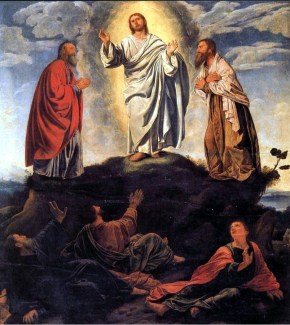
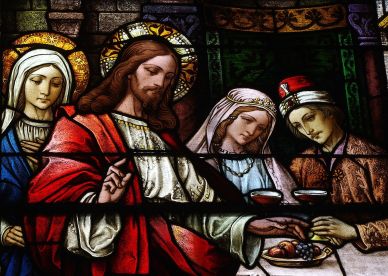 There is much worthy of reflecting upon in today’s gospel (Jn. 2:1-11) which gives the account of our Lord’s first public miracle – the turning of water into wine and the wedding in Cana. We can see in the image of the couple running out of wine on their wedding day a symbol of the ending of the Old Covenant and the freshness of the New Covenant beginning with our Lord turning water into wine. We can see in Mary’s noticing of the wine running short a concern for the young (and probably poor) couple who will soon be greatly embarrassed by not being able to provide for their guests. The first step of true mercy is noticing needs and not being indifferent toward others in their plight. This is a good witness Mary gives us during this Year of Mercy.
 The Alternate Path