Tags
Christianity, Easter, Easter 2019, faith, Jesus, primerea, resurrection
 In a recent interview on the life of faith and discipleship, Pope Francis shared an expression often used in Argentina – the expression is “primerea”. “…the Lord ‘primerea,’ anticipates us, waits for us; we sin and He is waiting to forgive us. He is waiting to welcome us, to give us His love, and each time faith grows.”
The Holy Father shared the expression in response to a question where he was asked about whether he ever felt betrayed by God. “Never,” responded Pope Francis. “I was the one who betrayed Him. At times I even felt like God was turning away from me, just as I turned away from Him. At very dark moments you ask yourself, ‘Where are you, God?’ I always believed that I was looking for God, but really it was He who was looking for me. He always gets there first and waits for us.”
The Lord “primerea”.
On Easter morning, Mary of Magdala comes to the tomb … it is empty. Peter and John run to the tomb and all they find are the burial cloths. The tomb is empty. It is empty because the Lord primerea!
A closed tomb is the opposite of primerea – there is no life, life is ended. All that the closed tomb offers is loss, sadness and pain. Life, on the other hand, by its very nature moves forward! It cannot remain stagnant nor be held back – the stone is rolled away and the tomb is emptied because the Lord primerea!
The Lord leaves the tomb in order to anticipate us, in order to show and be the living mercy that forgives us now and ever again on our journey. Even though this Easter Sunday we mark and proclaim in faith that greatest of events which occurred centuries ago when our Lord was bodily raised triumphant from the dead, the truth of the resurrection – and what it means for all time and creation – does not remain in the past. The truth of the resurrection is found in our today and in our tomorrow because this is where the risen Lord awaits us. The Lord primerea!
As Pope Francis remarked, “(The Lord) always gets there first and waits for us.”
Life calls us forward and Jesus is life itself! “Where is the resurrection?” some might ask. Others might demand that we point it out in order to prove it to them! I can say that it is not to be found in the history book nor in a museum. It is found right now and it resides in tomorrow. This is why on Easter Sunday we have this strange little reading about yeast. It is a strange reading really, and why – of all days – do we have it on Easter Sunday? You would think that there would be a reading proclaiming a blare of trumpets and choirs of angels singing. But, no, on our holiest day the Church has chosen this reading. Why?
Old yeast has no life, it produces nothing. It is like the enclosed tomb. But a little yeast that is true leavens all the dough – this little yeast brings life and it brings newness! And it does it truthfully and without the need for fanfare. Christ has been sacrificed and Christ has been raised!
True life does not need spectacle in order to prove itself. The resurrection does not need to prove itself to us nor does the one who is raised need to. Life reveals itself by being life. The resurrection is shown within the hearts that have been enlivened by it, by the hearts that encounter Christ today and move toward tomorrow in hope because the risen Lord awaits them there.
The tomb is empty! The Lord is risen!
The Lord primerea!
 What was our Lord writing on the ground with his finger? No one really knows but it is an interesting addition that the gospel writer makes to this narrative and it does lead one to wonder. What was he tracing on the ground?
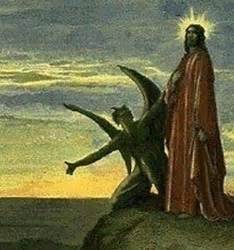 Have you ever noticed that each of our Lord’s temptations in Luke’s Gospel is a temptation to something within the immediate and that our Lord responds to each temptation by his hope in the future? That Jesus responds by not getting stuck in the immediate but by looking beyond the immediate to the infinite?
 “What does discipleship look like?’’ This was a question we were asked again and again in theology studies. What does it look like? How do disciples act in the world? How does one show that he or she is a follower of Christ?
 I go to the YMCA to exercise and for anyone who has been there you know that once you enter the building and head down the main hall there is a lounge area on the left and on a table in this room there is always a puzzle being worked on. I have begun the practice of spending three to five minutes at this puzzle after I exercise and before I leave. My goal is to try to get at least one piece of the puzzle in place. (The last time I was there I got three pieces in … I was quite proud of myself!) I could easily spend hours at this table because I like puzzles but I am learning that there is something good about limiting myself to just one or a few pieces at a time and also seeing how the puzzle comes together as other people also work on it.
 You may have noticed that Seth who oversees our parish maintenance has placed the animals in the stable scene outside in front of our church. I appreciated this as the day after he put the figures out I came across this quote from the author Evelyn Underhill,
 As some of you know I recently went to Yellowstone National Park and led a retreat there. Before and after the retreat I had free days so I took advantage of those days and went on some hikes. The first day going in I stopped at the ranger station just to check on things and make sure there were no concerns about the trails I was considering. The ranger suggested that I download the Yellowstone Park app as it would be a help to me. I took his advice and downloaded the app. It was a great help. What they have done at Yellowstone (and I am not sure if this is at other parks or not) is that they have mapped out every trail in the park on this app. Not only that, but when you go out on the trail you take your phone with you, switch it to airplane mode so that it is not continually searching for coverage and draining your battery and with GPS the phone shows you via a little dot on the screen exactly where you are at on the trail. One phone in the vast expanse of Yellowstone communicating with some satellite in the sky telling you exactly where you are at and which way to turn when the trail splits. I just find that level of technology, connection and focus amazing!
 A joke – an elderly couple were visiting the county fair. While wandering around they noticed that helicopter rides were being offered for fifty dollars. The wife turned to the husband and excitedly said, “Let’s go on a helicopter ride!” The old man just shook his head and replied, “Honey, that’s a lot of money. Fifty dollars is fifty dollars.” and they walked off. The next year the same couple was back at the fair and again helicopter rides were being offered for fifty dollars. The woman wanted to go for a ride but again her husband just shook his head and said, “Sorry, fifty dollars is fifty dollars.” The woman sighed and the old couple walked off. The next year, they were again back at the fair and again helicopter rides were being offered. Again the wife asked her husband to go up on a ride but again the man answered “Fifty dollars is fifty dollars.” This time though the pilot was nearby and overheard their conversation. He stopped the couple and said, “Listen, I will make you a deal. I will take you up and give you the best and most thrilling helicopter ride of your lives and if I hear not a single thing from you – no words, no laughing, no exclamations – your ride will be free!” The old man – always quick to get something for nothing – immediately said yes and up the three went in the helicopter! The pilot was true to his word – it was the best and most thrilling helicopter ride! The day was beautiful and you could see for miles! The pilot, to add a little excitement (and try to get some sound out of the two) even steeply banked the helicopter one way and then the other way throughout the ride. The pilot was amazed though because throughout the whole ride he heard not one sound from the elderly couple. Finally, after landing he turned around and realized that the old man was not in the helicopter. “Where is your husband?” he asked the woman. “Oh, he fell out about thirty minutes ago.” Shocked, the pilot asked, “Why didn’t you say something?!”. “Well,” she said, “fifty dollars is fifty dollars!”
 When questioned about the accusations in the letter written by Archbishop Carlo Viganó on the return flight to Rome after the World Meeting of Families in Ireland, Pope Francis did something quite revolutionary I think. He did not just say, “I will not say a single word on this” as many people have been focusing on. He went on to do something else, he opened a door and he made an invitation.
 I have been ordained for twenty-three years now and my entire priesthood has been lived under the shadow of the clergy abuse scandal. It began when I was in seminary in Chicago. I remember spending the days in prayer, class and formation for priesthood and then watching the six o’clock evening news as the latest wave of the scandal broke. Talk about a disconnect! But seminaries (by their nature) exist in a bubble. After ordination there was the news from Boston and other parts of the country but that was “out there” – still somewhat removed. It all came crashing home when the bishop who ordained me was accused of abuse and admitted to this abuse. He spent the remainder of his days praying and working in the laundry room of a monastery. A priest from my diocese (former pastor to the parish to which I now serve) was arrested and is currently in prison for abusing a child. A priest classmate was removed from ministry for inappropriate contact with a minor. And now it is all stirred up again with the recent report from Pennsylvania. My whole priesthood and the priesthood of now at least a couple of generations of priests has been lived under the shadow of this scandal.
