
Tags
bigotry, Charlottesville, Christian life, Christianity, faith, prejudice, racism, social justice, White supremacy
 In light of the violent and tragic events that have occurred in Charlottesville, VA a dear friend asked me what can one person do “on a regular basis to fight racism and some of what’s going on in this country/world?” It is sad and frightening what is going on in our country and what we see happening in our world. We must reaffirm that there is no place for bigotry, prejudice and violence in our country, our world and in our hearts as Christians and, I think, we must do this as we also reaffirm and in many ways, rediscover, the value and unique power of Christian community.
In Matthew 18:15-20 our Lord gives his disciples some instructions on the reality and role of Christian community. “If your brother sins against you,” our Lord says, then go and tell him the fault, if he fails to listen then take one or two others along with you and if he still refuses to listen then tell the Church and if he fails to listen even to the Church, “then treat him as you would a Gentile or tax collector.” It is worthy to note that Jesus often entered into relationship with the Gentile and tax collector throughout his ministry and that he sought their healing and salvation. Jesus then gives to the community the authority to bind and loose. “Amen, I say to you, whatever you bind on earth shall be bound in heaven, and whatever you loose on earth shall be loosed in heaven.” Our Lord then doubles down on the unique power and authority of the church community. “Again, amen, I say to you, if two of you agree on earth about anything for which they are to pray, it shall be granted to them by my heavenly Father. For where two or three are gathered in my name, there am I in the midst of them.”
The power of the Christian Church, the power of our Christian faith, is a weak power. We do not have the force of arms or military or police might, neither do we have economic or even (in our increasingly secular age) social might. What we do have is the presence of Christ in our midst and the gift of the Holy Spirit. This alone is that power that can bind and loose and that can open and call forth the grace of heaven through prayer.
Like many people, I viewed the Vice media video that recorded and interviewed the white supremacists during these horrendous days in Charlottesville. I was truly shocked by the vitriol, hatred and anger expressed by these people and I was also extremely saddened for them because I saw people locked in fear and hate. Theirs is a pseudo-community. Despite the bravado and the appeals to white unity there is no community there. They are people locked in a sad echo chamber stoked by the negative isolation of social media, resentment, fear and ignorance. They are imprisoned in their hate.
To this pseudo-community we are called to be community in Christ – the only true community that can both bind and loose and here is found our unique weak strength. Because Christ is with us and the Holy Spirit has been given us we can both bind and loose. Through the living of Christian community, we can work to truly bind those forces in society and the human heart that seek to separate and isolate each one of us in resentment and fear. Through the living of Christian community, we can even help to loose those brothers and sisters who have become bound by resentment and fear. This has been my prayer and my hope since I have viewed those sad images coming out of Charlottesville. Pseudo-community only leads to a sad mockery and false caricature of human dignity. All the pseudo-communities of our time must be met by the true community of the disciples gathered in prayer, truth and the mercy and the grace known in Christ.
There are many sad and broken things that lie at the root of the violence and hatred given expression in Charlottesville the past few days. One of these, I believe, is a crisis of true community in our society. People are isolated, people are lost, there is pain, uncertainty and fear and in such circumstances the false appeal of pseudo-community can be strong and alluring. This is all the more reason for us to strive in humility, love and grace to be Church – the community where Christ is present and where the Holy Spirit is given and the only true community that has the power to bind and to loose.
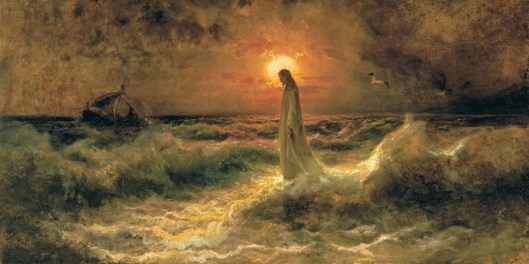
 In our social media driven world I sometimes find myself wondering “WWJP?” or “What would Jesus post?”
 It is interesting how some things stay with us and even become operating principles in our lives.
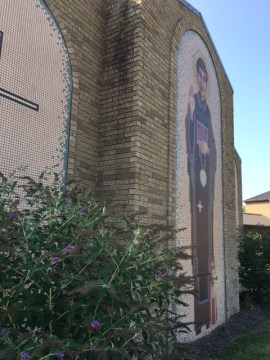 What is best for the environment? This is a question I find myself continually returning to after reading Pope Francis’ encyclical “Laudato Si” as well as my own growing interest in protecting and safe-guarding creation. Do the plants and shrubs we favor around churches help benefit the environment or do they just look nice from our human perspective? Can our parish grounds themselves become places that benefit and support creation? A couple of years ago now I planted two butterfly bushes in front of our Parish Life Center because they fit and enhance the space, they are low maintenance and hardy and, in regards to this question, they are a benefit to bees and butterflies. A simple choice in a planting can have ripples of effect.
 Wolves (for which I have always had an interest in since I was a child) were my main interest in visiting Yellowstone but during these days I was also thrilled to view numerous black bears (a few with cubs), bison, elk, mule deer, bighorn sheep, pronghorn, an osprey nest inhabited by mother, father and two chicks, foxes, coyotes, badgers, a bald eagle flying and numerous smaller animals and birds.
![IMG_5641[3392]](https://thealternatepath.org/wp-content/uploads/2017/07/img_56413392.jpg?w=290&h=193) For a week, I was “unplugged” – to some degree. Other than sharing some pictures on Facebook and Instagram and talking with the people I met or was around during the day I had no idea what was going on in the world. I would rise early to get into the park before the heat of the day became too oppressive, return to Gardner for lunch and a short siesta and then return into the park not to leave until late in the evening.
For a week, I was “unplugged” – to some degree. Other than sharing some pictures on Facebook and Instagram and talking with the people I met or was around during the day I had no idea what was going on in the world. I would rise early to get into the park before the heat of the day became too oppressive, return to Gardner for lunch and a short siesta and then return into the park not to leave until late in the evening. Although I have an interest in wolves and have now spotted three packs during my two visits to Yellowstone I do not think I have some “mystical” connection with them because the wolves are unconcerned about me and that is the way it should be. The wolves are just out there being wolves and if something were to happen and all of sudden humanity disappeared from the face of the earth the wolves, bears, bison, elk and all animals would just continue continuing on. But the wolves and other animals are of concern to me and that is what makes me human.
 Reflecting on the reality of baptism, Diadochus – a theologian of the early church – writes, “Before a person comes to be baptized, grace is at work, from without, encouraging the soul toward the good, while Satan is at work, from within. After baptism, the contrary is the case. Grace works from within and the demons from without. These continue their work, and work even more evilly than before, but not as present together with grace. The only way they can work is through the promptings of the flesh.”
 On the recommendation of a parishioner, I recently watched the Swedish movie, “A Man Called Ove” – based on the 2013 novel by the same name written by Fredrik Backman.
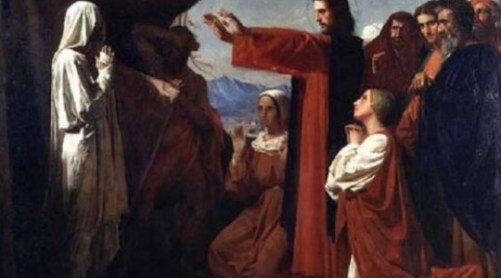 There is almost an ordinariness to the way our Lord goes about his mission of proclaiming and living God’s Kingdom.
 In the gospel (Mt. 17:1-9), our Lord takes Peter, James and John up on a high mountain and is transfigured before them. Our Lord’s face shone like the sun and his clothes became white as light. Moses and Elijah appear and converse with our Lord. Peter wants to build three tents on the spot but while he is speaking we are told that a bright cloud cast a shadow over them. This immediately gets our attention, something utterly unique is occurring. How can a cloud be “bright” and what does it mean that it casts a shadow over them?
 The Alternate Path