 In Mt. 25:14-30 we find our Lord sharing the parable of the talents. Three servants are given different amounts of treasure to invest for their master while he is away – one is given five talents, the second is given two and the third is given one talent. On the master’s return we learn that the first two servants doubled what was entrusted to them (and were therefore rewarded generously by their master) while the third literally buried the talent away that he had been given. He neither lost nor gained anything for the master and was therefore called out on his laziness and was punished by being cast into “the darkness outside.”
The three servants did not own these talents. This is important to note. The talents were given and entrusted to them by the master upon his departure with the expectation that they would be returned and increased upon his return. The master is the only one in the parable who has a rightful claim on the treasure. I do not believe that the parable is about developing our own skills, gifts and abilities (as important and praiseworthy as this might be) but rather about something much deeper and transformative. The Christian has been given things by God in Christ – things that we have no claim to on our own – and the Christian is expected to make these things grow and will be judged accordingly.
Before getting into what I believe is one set of things given to us by God in Christ I would like to propose that the temptation to live according to a closed secularism – so prevalent in our world today – is the temptation and failure of the third servant. (For a helpful presentation of the distinction between a “closed” and “open” secularism, I would refer you to the book Church, Faith, Future: What We Face, What We Can Do by Fr. Louis Cameli.)
The third servant, out of fear, buried the talent entrusted to him. God calls us to the freedom of his Kingdom but such a freedom can be frightening. Remember the Israelites yearning to go back to the bondage of Egypt? Burying something away is a way of side-stepping and avoiding the responsibility of freedom. Burying also means ignoring. It is safe to assume that the third servant, after tucking away his talent, went about the business of his day and what he wanted to accomplish – not really thinking about the master until the day he shows up again. The first two servants, working to increase the talents given them, were active and they were continually thinking about and focused on the master’s return. They were not going about their own plans but were planning and working for their master even as he was gone. Their doubling what had been entrusted to them demonstrates this attitude. Finally, burying is choosing the lesser and valuing it over that which is higher. In our modern sensibility we stumble with this imagery but the highest goal of the servant should be that of seeking to fulfill the will of the master. The third servant placed his own security and his own designs over the task entrusted to him by his master. He therefore chose that which was lesser.
In the choice for a closed secularism we are in essence burying what has been given us. We are choosing the world before the Kingdom of God. We are side-stepping the true freedom of living as a son or daughter of God with its duties and responsibilities (and abundant graces) for the shallow pseudo-freedoms of choosing our next form of entertainment and/or distraction. We are ignoring the call and promise of God for the business of what we think our day should be about and therefore we are choosing that which is lesser over that which is greater.
Now, what has been given us by God in Christ that we have no claim to on our own? One gift, I believe, are the theological virtues and when we choose to live according to the narrative of the closed secular we, in essence, bury what has been given and entrusted to us. The Catechism of the Catholic Church teaches us that the theological virtues have their origin, motive and goal in God. These virtues, in the Christian understanding, are gifts from God and can only be brought to fulfillment through our having relationship with God. If God and the realm of the divine is bracketed out of our reality we sidestep the responsibility of the freedom of a child of God, we ignore God in favor of our plans and preoccupations and we lose sight of the greater in favor of that which is lesser.
Faith, rather than being the virtue that confirms our belief in what God has said and revealed is reduced to an allegiance to what I and my particular group believe and hold to be true above all else. Hope, rather than being that virtue anchored in the coming Kingdom of God – the virtue which pulls us forward through the tumults of life – becomes (at best) a naïve optimism rooted in the ever-changing slogans of the day. Charity, rather than being the love of God above all things for his own sake and our neighbors as ourselves for the love of God, becomes a bargaining with a God relegated to the role of being the source of my comfort and a care for those people within my own personal echo chamber – a care which allows only a grudging acceptance for those people without.
How do we avoid the failure of the third servant? We learn from the first two servants. We do not bury what has been given us by co-opting and choosing to live by the narrative of the closed secular. We remain active, living in such a way in the reality of today as to keep the Master in our thoughts and anticipate his return. We live in such a manner as to make the talents of true faith, hope and love grow in our hearts and in our world!
The temptation of closed secularism is the failure of the third servant. As in all the parables, there is much to learn here if we have the ears to hear.
 I am not much into church signs and I am glad that we do not have one here at St. Dominic’s because I am not witty enough to post a profound thought each week. I did see one church sign thought the other day that I did like though. It was, “Do not let self eclipse the Son.” Since we all survived the recent solar eclipse we can now breathe a sigh of relief! But the church sign thought is good and it connects well with the today’s gospel (Mt. 16:21-27).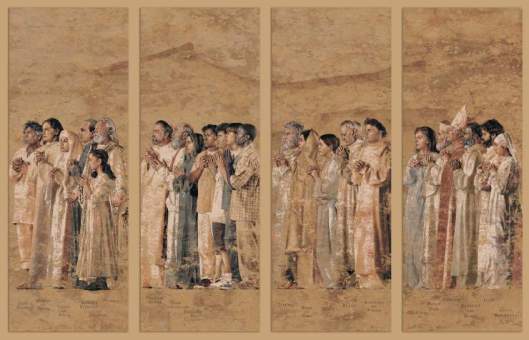
 In light of the violent and tragic events that have occurred in Charlottesville, VA a dear friend asked me what can one person do “on a regular basis to fight racism and some of what’s going on in this country/world?” It is sad and frightening what is going on in our country and what we see happening in our world. We must reaffirm that there is no place for bigotry, prejudice and violence in our country, our world and in our hearts as Christians and, I think, we must do this as we also reaffirm and in many ways, rediscover, the value and unique power of Christian community.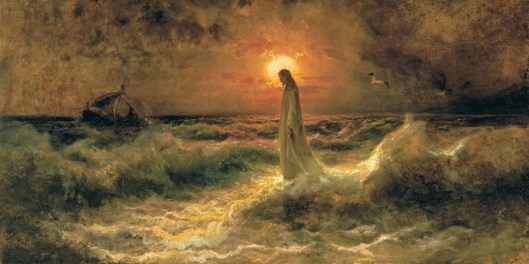
 In our social media driven world I sometimes find myself wondering “WWJP?” or “What would Jesus post?”
 It is interesting how some things stay with us and even become operating principles in our lives.
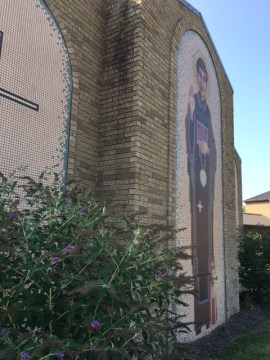 What is best for the environment? This is a question I find myself continually returning to after reading Pope Francis’ encyclical “Laudato Si” as well as my own growing interest in protecting and safe-guarding creation. Do the plants and shrubs we favor around churches help benefit the environment or do they just look nice from our human perspective? Can our parish grounds themselves become places that benefit and support creation? A couple of years ago now I planted two butterfly bushes in front of our Parish Life Center because they fit and enhance the space, they are low maintenance and hardy and, in regards to this question, they are a benefit to bees and butterflies. A simple choice in a planting can have ripples of effect.
 Wolves (for which I have always had an interest in since I was a child) were my main interest in visiting Yellowstone but during these days I was also thrilled to view numerous black bears (a few with cubs), bison, elk, mule deer, bighorn sheep, pronghorn, an osprey nest inhabited by mother, father and two chicks, foxes, coyotes, badgers, a bald eagle flying and numerous smaller animals and birds.
![IMG_5641[3392]](https://thealternatepath.org/wp-content/uploads/2017/07/img_56413392.jpg?w=290&h=193) For a week, I was “unplugged” – to some degree. Other than sharing some pictures on Facebook and Instagram and talking with the people I met or was around during the day I had no idea what was going on in the world. I would rise early to get into the park before the heat of the day became too oppressive, return to Gardner for lunch and a short siesta and then return into the park not to leave until late in the evening.
For a week, I was “unplugged” – to some degree. Other than sharing some pictures on Facebook and Instagram and talking with the people I met or was around during the day I had no idea what was going on in the world. I would rise early to get into the park before the heat of the day became too oppressive, return to Gardner for lunch and a short siesta and then return into the park not to leave until late in the evening. Although I have an interest in wolves and have now spotted three packs during my two visits to Yellowstone I do not think I have some “mystical” connection with them because the wolves are unconcerned about me and that is the way it should be. The wolves are just out there being wolves and if something were to happen and all of sudden humanity disappeared from the face of the earth the wolves, bears, bison, elk and all animals would just continue continuing on. But the wolves and other animals are of concern to me and that is what makes me human.
 Reflecting on the reality of baptism, Diadochus – a theologian of the early church – writes, “Before a person comes to be baptized, grace is at work, from without, encouraging the soul toward the good, while Satan is at work, from within. After baptism, the contrary is the case. Grace works from within and the demons from without. These continue their work, and work even more evilly than before, but not as present together with grace. The only way they can work is through the promptings of the flesh.”
 The Alternate Path