
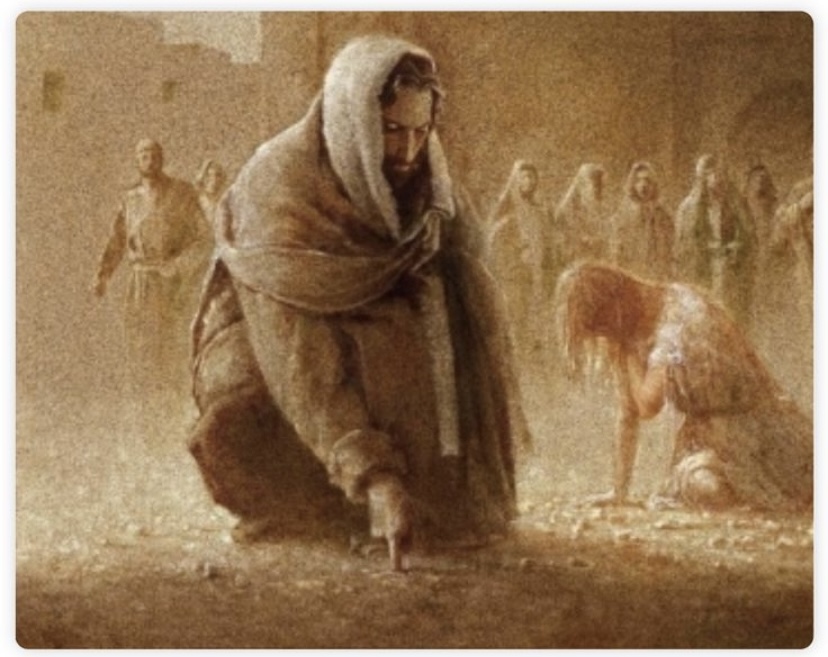
There are many circles of violence in this Sunday’s gospel story (Jn 8:1-11).
The woman is not without fault. She was caught in the act of adultery. That was a free choice on her part as well as a free choice by the man she committed the sin with. Adultery is an act of violence against the covenant of marriage. It is worthwhile to note that after everyone walks away Jesus says, “Neither do I condemn you.” It is in the mercy of God that she is freed from condemnation but there is judgment on her sin, her participation in that act of violence. Jesus says, “Go, and from now on do not sin anymore.”
The crowd is also caught up in the circle of violence as they stand ready to stone this woman. These two circles of violence (the act of adultery and the desire to kill) are clearly visible and apparent but there are still other circles of violence. There is a further circle of violence against the woman – she is being used. The gospel lays it out clearly. The scribes and Pharisees are using the woman to try to trap Jesus. “They said this to test him, so that they could have some charge to bring against him.” They have no real interest in the woman, their focus is on Jesus and she (and apparently even her very life) means nothing, she is just a means to get at Jesus. To reduce another person in any circumstance to a “means to an end” is an act of violence.
There is a further and even more profound act of violence. The scribes and Pharisees, so proud of their religious observance, are trying to use both the commandments and even God. Again, their intent here is to trap Jesus and not to give honor to the commandments of God and therefore, even God himself. On their lips they say, “Now in the law, Moses commanded us…” but in their hearts their intent is far from giving honor to the law but rather to trap Jesus. It is in their intent that we see that they are trying to reduce the commandments of God and even God himself to a means to an end. This is an act of violence. God will never be reduced to a means to an end.
All of these circles of violence within eleven verses.
Probably beginning the very day that these verses were written, we have wondered what it means that Jesus bent down and wrote on the ground. There are all sorts of interpretations of this action. A thought that I have is that, by this simple action, Jesus is clearly showing that he will not participate, he will not get caught up in any of these circles of violence. He will not condone the woman’s act of violence, he will not get caught up in desire to kill, he will neither use a person nor his heavenly Father as a means to an end. He will not … by writing in the sand, our Lord demonstrates his refusal and disdain for all these circles of violence.
Once he straightens up and looks around, the answer he gives immediately cuts through all of these circles of violence. “Let the one among you who is without sin be the first to throw a stone at her.” All walk away. The circles of violence have been broken, no stronger than the dust Jesus was just drawing in.
Throughout his preaching, St. Paul never tired of letting people know how he had persecuted the church before his encounter with Christ. St. Peter, never tired of sharing how he had denied knowing Christ in the courtyard of the high priest. Both men and all of the apostles never tired of sharing how Jesus had rescued them from the circles of violence in their lives and how Jesus shows us a different way and makes it possible for us to live this way.
Isaiah foretold it, “Thus says the Lord, who opens a way in the sea and a path in the mighty waters … In the desert I make a way, in the wasteland, rivers.” (Is. 43:16-21)
Now, in Christ, we do not have to live in the circles of violence. We do not have to participate. We do not have to get caught up in the violence. There is a different way. We find it when we allow Jesus to find us.
Jesus sets us free to walk this new way.
 A joke – an elderly couple were visiting the county fair. While wandering around they noticed that helicopter rides were being offered for fifty dollars. The wife turned to the husband and excitedly said, “Let’s go on a helicopter ride!” The old man just shook his head and replied, “Honey, that’s a lot of money. Fifty dollars is fifty dollars.” and they walked off. The next year the same couple was back at the fair and again helicopter rides were being offered for fifty dollars. The woman wanted to go for a ride but again her husband just shook his head and said, “Sorry, fifty dollars is fifty dollars.” The woman sighed and the old couple walked off. The next year, they were again back at the fair and again helicopter rides were being offered. Again the wife asked her husband to go up on a ride but again the man answered “Fifty dollars is fifty dollars.” This time though the pilot was nearby and overheard their conversation. He stopped the couple and said, “Listen, I will make you a deal. I will take you up and give you the best and most thrilling helicopter ride of your lives and if I hear not a single thing from you – no words, no laughing, no exclamations – your ride will be free!” The old man – always quick to get something for nothing – immediately said yes and up the three went in the helicopter! The pilot was true to his word – it was the best and most thrilling helicopter ride! The day was beautiful and you could see for miles! The pilot, to add a little excitement (and try to get some sound out of the two) even steeply banked the helicopter one way and then the other way throughout the ride. The pilot was amazed though because throughout the whole ride he heard not one sound from the elderly couple. Finally, after landing he turned around and realized that the old man was not in the helicopter. “Where is your husband?” he asked the woman. “Oh, he fell out about thirty minutes ago.” Shocked, the pilot asked, “Why didn’t you say something?!”. “Well,” she said, “fifty dollars is fifty dollars!”
 The “eye for an eye” teaching that our Lord refers to in today’s gospel (Mt. 5:38-48) was actually an attempt to restrict violence in a time when revenge was indiscriminate and excessive.
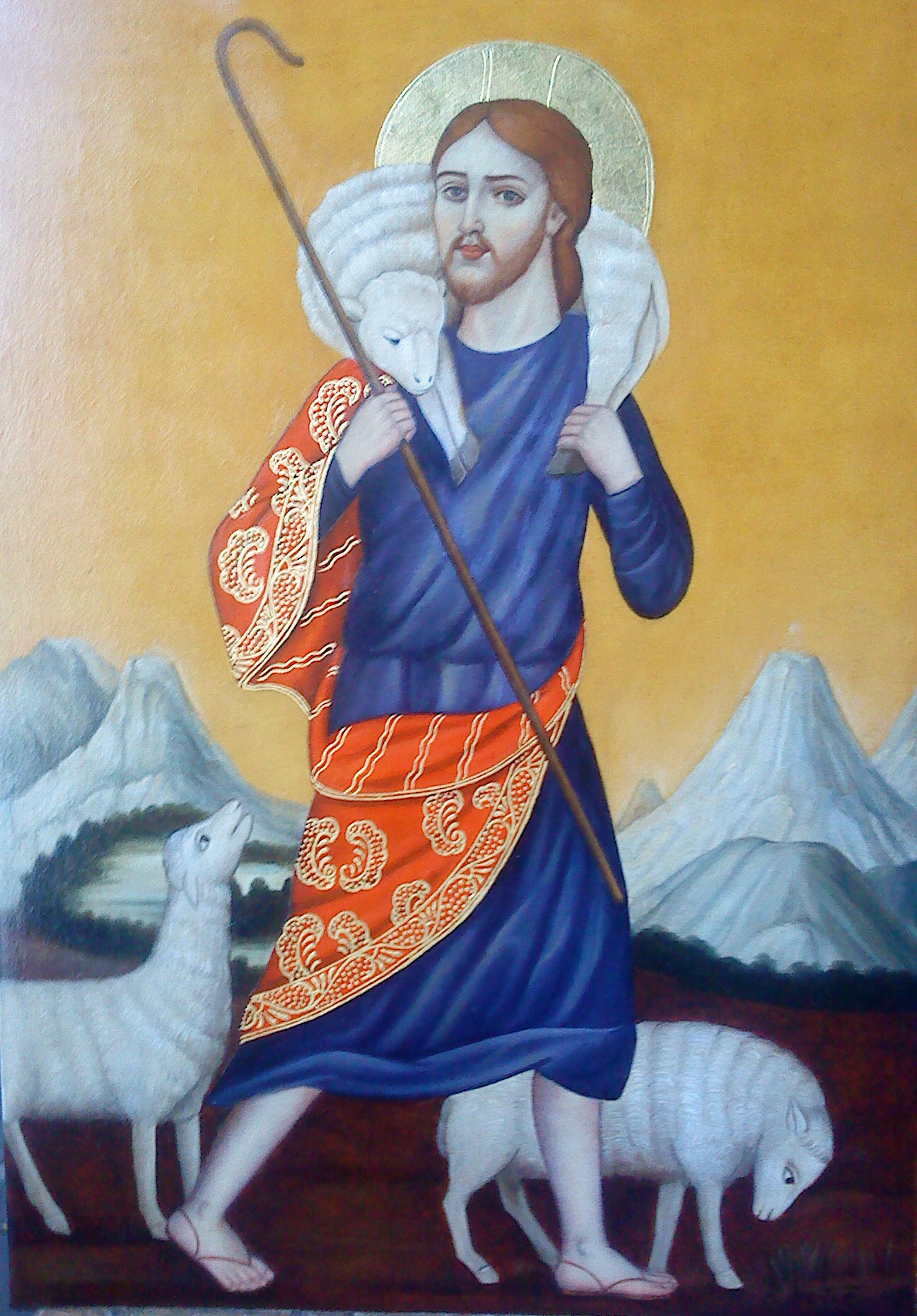 One of the truths revealed in today’s gospel (Lk. 15:1-10) is that our God is not a God content to let people remain anonymous. The shepherd goes out in search of the lost sheep because that one sheep truly matters to him. The woman turns the house over searching for the lost coin because that coin is of real concern to her. We are of concern to God. We are not alone in a vast universe governed by random chance. We do not have a God who does not care. God is willing to seek each one of us out, willing to even enter the darkness of sin and death, to find us and then rejoice in the finding!
 Jewish midrash is a way of interpreting Hebrew Scripture that seeks to fill in the gaps and therefore bring forth truths of faith. A midrash on the scene of God appearing to Moses in the burning bush that we heard in the first reading (Ex. 3:1-8a,13-15) holds that the bush had thorns. God witnessed the suffering of the Hebrew people in Egypt, their daily struggle and pain, and therefore God chose to reveal Himself to Moses in the midst of a thorn bush to show that He is a God who is present in the midst of the suffering of his people.
 hrist comes to reveal the truth of who God is and to call us into relationship with Him because here and only here is where we will find true life. What choice will we make? We each have only so many days allotted us.

 The Alternate Path